
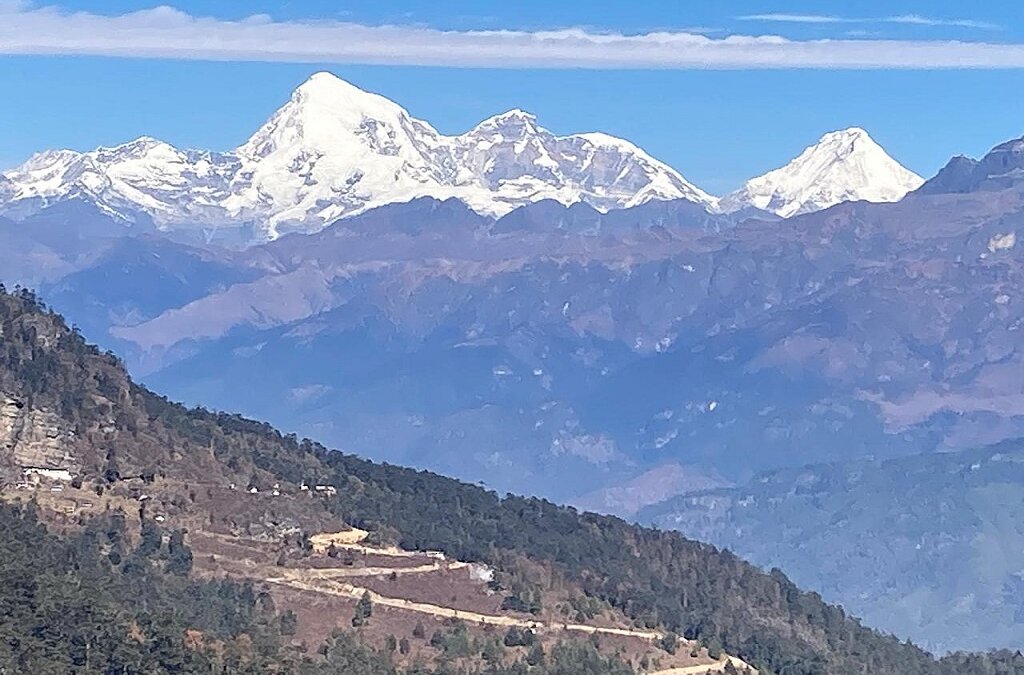
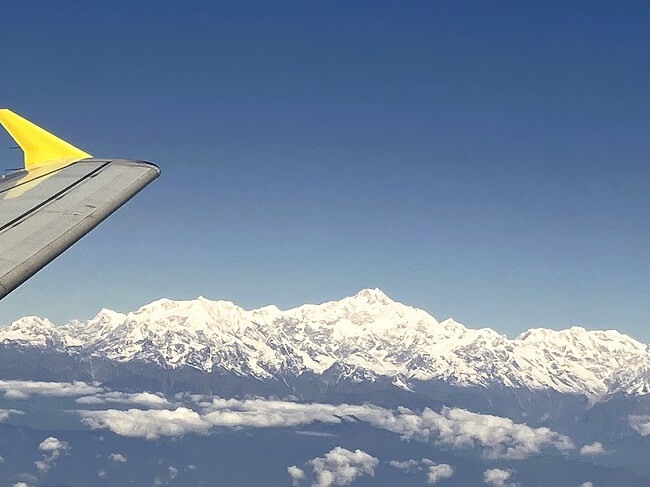
The highest mountain peaks in the world – Mount Everest and Kanchenjunga – glistened in the sunshine as our plane slowly drifted down, weaving through valleys flanked by verdant hills.
Who needs in-flight entertainment when you can see the Himalayas from the aircraft window?
Soon we arrived at the Land of Happiness – Bhutan.
Why this name, you may ask.
Because Bhutan is the only country that does not measure GNP (gross national product) to determine prosperity. It measures GNH (gross national happiness) to determine the level of well-being of its people. And yes, the GNH number is increasing steadily!
Let’s step back a little.
Bhutan is a tiny country, with a population of about 800,000 people living in a very mountainous nation slightly smaller than Switzerland, of which 74% is thick forest. The altitude varies dramatically from about 300 m (1,000 ft) to about 7,500 m (24,800 ft). The average elevation in most places is about 3,000 m (10,000 ft).
It lies at the eastern end of the Himalayan mountain range, sandwiched between powerful neighbours – China and India – to its North and South.
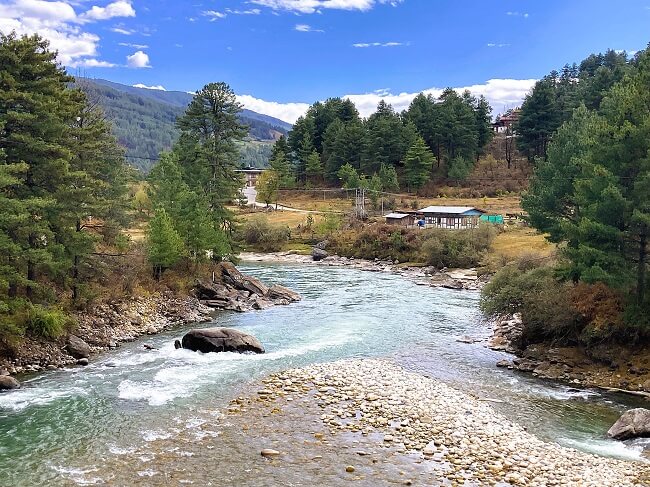
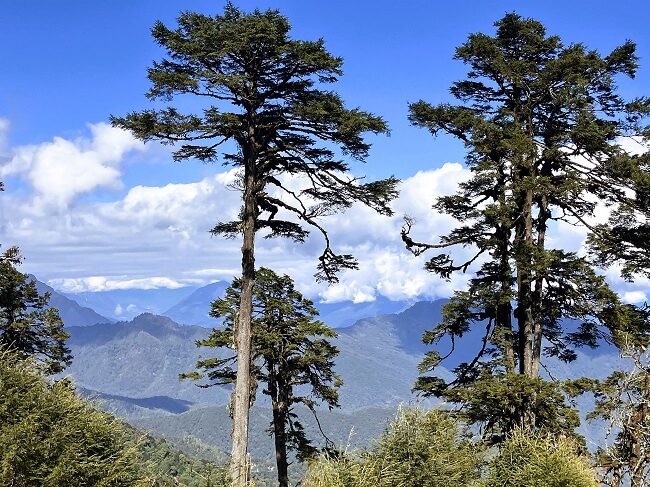
Some things struck us immediately upon arrival:
– Everything is colourful and spotlessly clean.
– Everyone speaks English.
– People follow a dress-code (See below)
– And yes, people smile a lot, look happy, and are extremely polite and helpful.
TRADITIONAL BHUTANESE COSTUMES
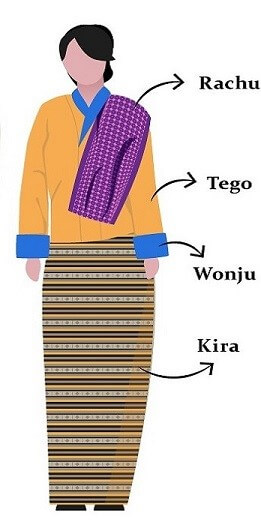
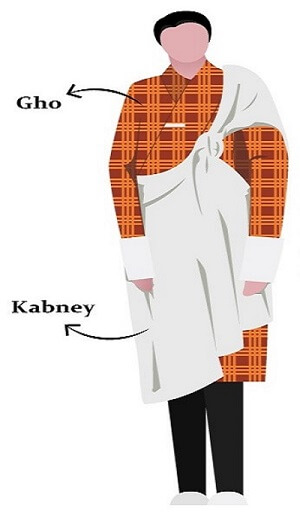
Everyone, even toddlers, wear clothes of a standard pattern, with a variety in colours or design. Women wear ‘Kira’ – a long ankle-length dress that wraps around the body. Men wear the traditional ‘gho’ – the knee-length robe with long sleeves and loose fit.
Formal wear for men requires the addition of a plain shawl wrapped over the torso, which is colour coded – bright yellow for the Royal family, orange for the Prime Minister, blue for members of parliament, and so on, while ordinary citizens wear white.
A few more unusual things:
– There are no traffic lights anywhere, though there are traffic policemen in a few places. Everyone follows one rule – give way to the person on your right.
– Smoking is (virtually) banned. You cannot smoke in “public spaces”, which includes roads and open spaces.
– Though education and healthcare are free, there is no old age pension. Not needed, because children take care of parents. No children? Relatives and neighbours chip in.
– When the ruling Monarch tried to introduce democracy, people protested because they wanted to be ruled by the King. Eventually, the people yielded, and now there is an elected Parliament.
– Foreigners cannot roam around Bhutan on their own. You must have a licensed guide with you at all times.
Overall, people follow social norms in everything, of their own accord, whether or not anyone is watching.
FOOD and DRINKS
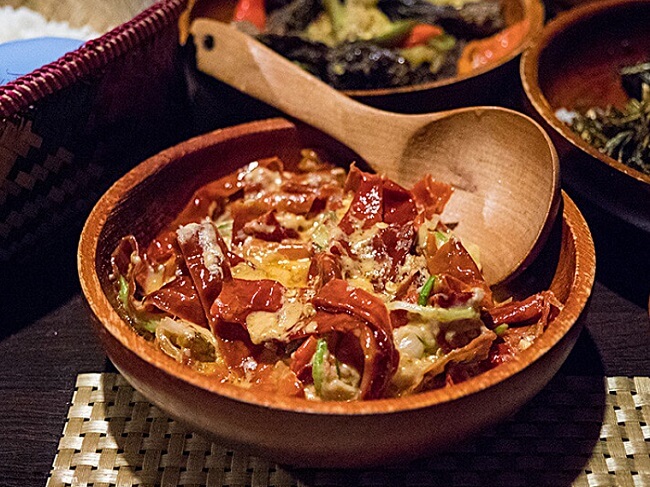
Some bits of it are unusual, like tea made with salt and butter, or red chillies mixed with cheese – a mandatory side-dish.
But no worries, wholesome and very palatable food is available everywhere, and the hotel buffets give plenty of choice. Every kind of meat (including Yak) is served, and alcohol is freely available. Careful – be sure to check the level of spiciness before you try anything unknown.
Some dishes can be dynamite.
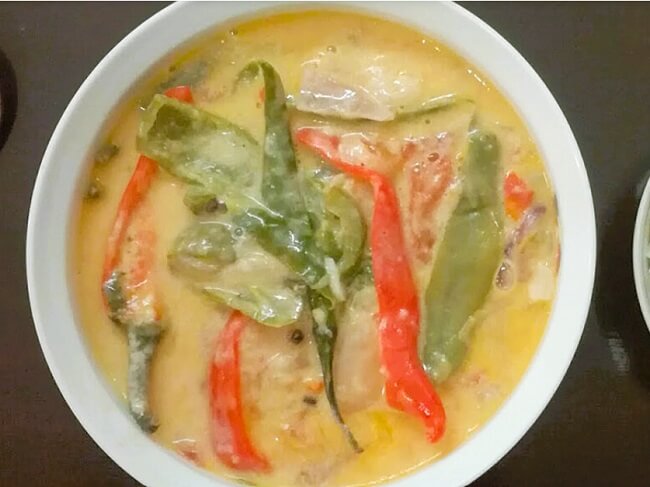
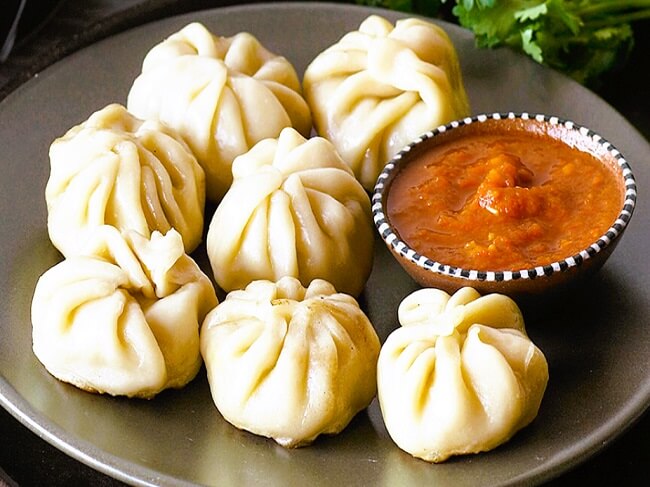
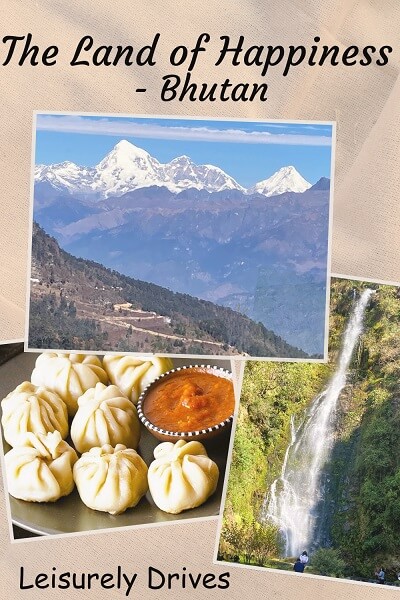
Some popular favorites are Phaksha Paa (pork with chillies), Jasha Maru (stewed minced chicken – unique), Momos (dumplings), and Ema Datashi (chilli and cheese stew).
SIGHTS
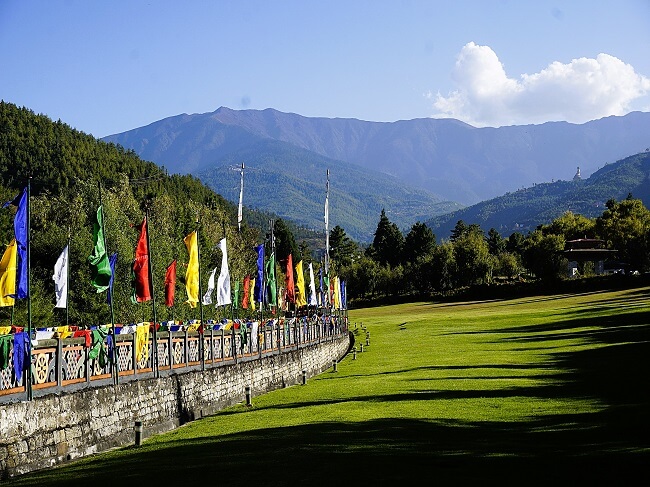
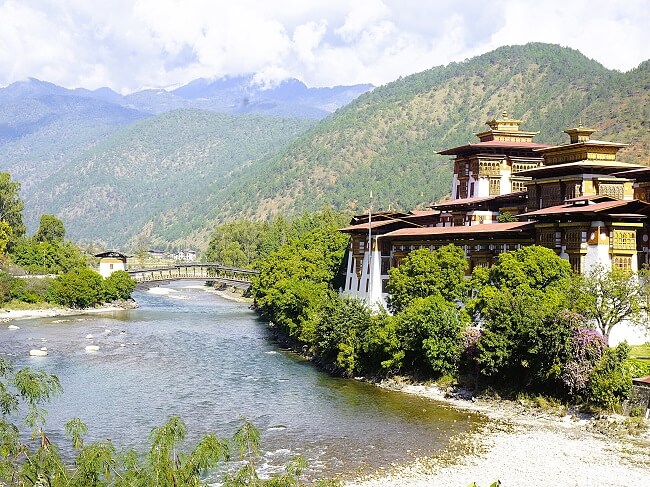
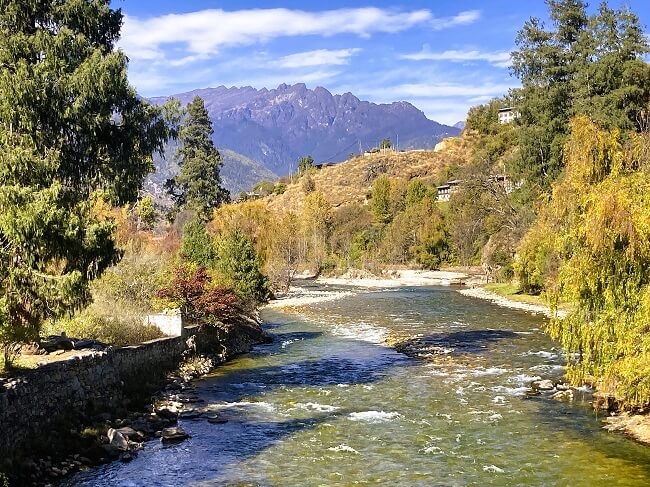
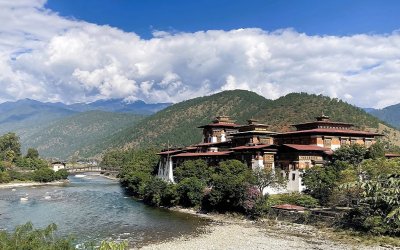
There is plenty to see, and the overall ambience is – in one word – outstanding.
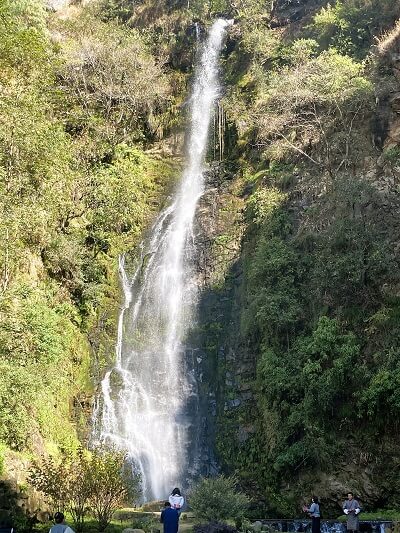
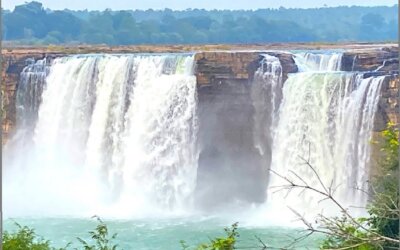
There are peaks and valleys, waterfalls and rivers, gardens and forests, plus monuments, giant statues, temples, old forts, museums – you name it.
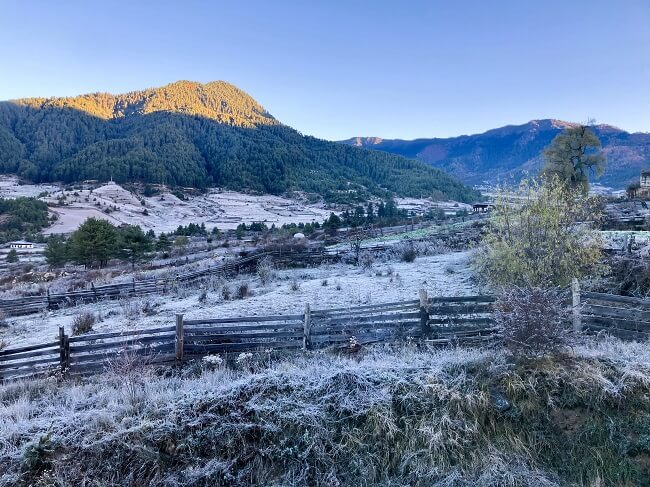
We were lucky to be here in the second half of November, when the sky was a clear blue and the air crisply cool, so that far-away snow-capped peaks were clearly visible.
In this blog post, we have shared a few glimpses of the enchanting scenery and colors that we came across.
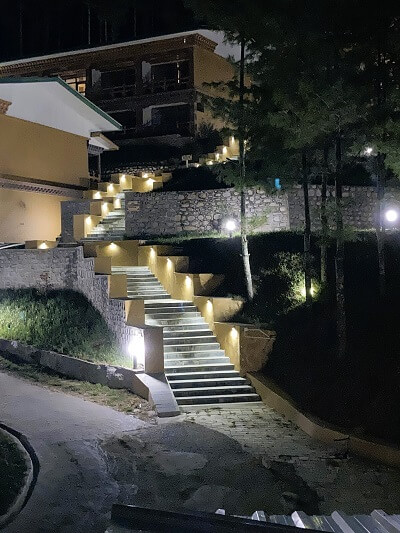
The only hitch we faced in Bhutan was the climbing. Steps and slopes, often quite steep, are everywhere, and you need strong legs and knees to get around to all the places that you want to reach. See the image below – 82 steps from dining room to hotel room!
Yes, it was a bit tough at times, but truly worth the effort.
HIKING and TREKKING
Bhutan offers myriad options for adventures on foot, from short hikes to extended treks over mountains that involve many nights of camping under the stars. Of course, this was not our cup of tea, but if it is yours, Bhutan is a great place to visit.
HOTELS
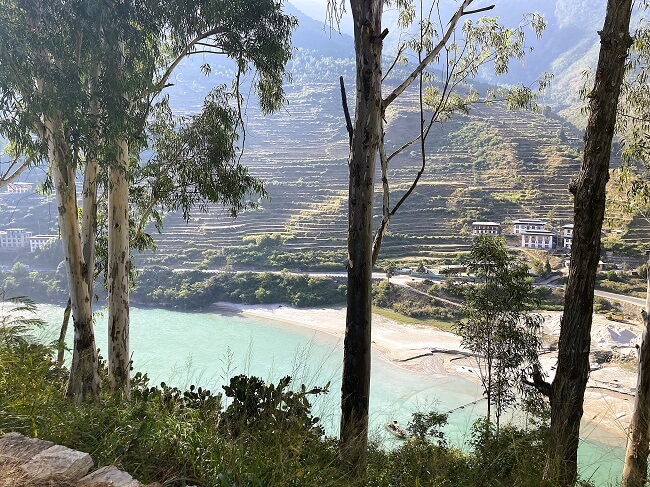
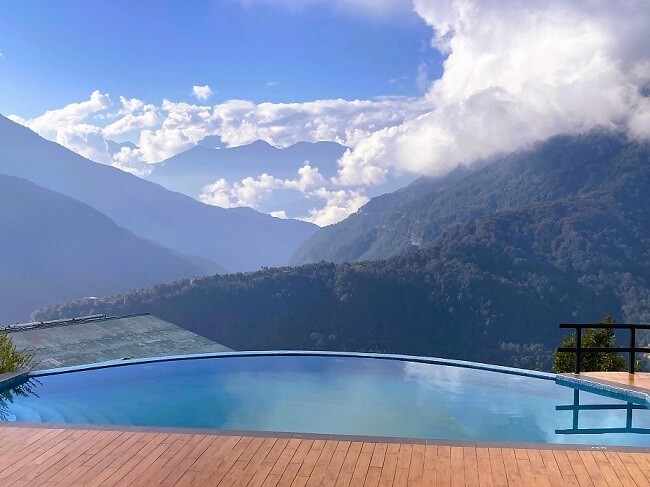
Bhutan is not a crowded country, and charming sceneries are aplenty. Consequently, it is not difficult to find great locations for hotels.
The ones that we stayed in, though not 5-star, were beautifully located properties with more-than-adequate living spaces. The staff were always helpful, attentive and smiling, putting in great effort to make us really comfortable. Food was good to excellent. Yes, WiFi was quite patchy in most hotels due to the mountainous nature of the landscape. Overall, the hotels were very good.
TRAVEL
Sorry, tourists are not allowed to drive rental cars in Bhutan. You need to rent a car with a driver, in addition to the mandatory guide!
The highways, which connect the major towns, are very good, and traffic is sparse. The inner roads, such as the ones that connect the highways to villages, are moderately good, and the final stretches to the hotels (fortunately, a few hundred yards at most) can be unpaved and bumpy.
Speeds are absurdly low, the average on the highways being about 25-30 mph. As a result, journeys between towns can be quite long, but not fatiguing, because the fascinating scenery keeps you engrossed.
Finally,
THE GUIDE
Being independent travellers, it is inherently uncomfortable for us to have a strange person with us all the time.
Fortunately, our guide was excellent – very well spoken, knowledgeable, punctual, and attentive to our needs.
Becoming a licensed guide is not easy. One has to be educated, fluent in English and thoroughly aware of all aspects of Bhutanese history and culture. Hence, chances are that the guide you will find (there are quite a few women, too) is very likely to be of the ‘right” sort.
We felt the need to share some details about this beautifully quirky country, so different from any of the others that we have visited.
As regards the sights, more blog posts are coming up soon..
This is a very interesting article. Is there a reason why visitors need a guide to travel around with them and why they are unable to rent a vehicle. I love how they have the happiness index!
No self driven cars primarily for safety, road management and environment protection, I presume. Guides mandatory due to its ‘high value, low volume’ cultural protection. That is the state law. 🙂
What a fascinating and beautifully described introduction to Bhutan. The focus on Gross National Happiness, everyday traditions, and the natural setting really shows why the country feels so unique and special. It sounds like an unforgettable journey, even with all those steps—absolutely worth the effort. Bhutan isn’t the easiest place to reach, and it’s far from a typical tourist destination. That’s why guides like this are so valuable and rare—your detailed insights make the country feel approachable without losing its magic.
I love all of the information you provide. So many things we would not know it we decided on a whim to visit without doing any research before.
Traveling to Bhutan and enjoying some of the hiking sounds wonderful. Out of curiosity, why are the travel speeds so slow along the highways? It sounds like the roads are in good shape and aren’t too crowded.
I guess it is due to its challenging, winding Himalayan roads, with priority for safety and aligning with its GNH philosophy! 🙂
What a unique country. “Awesome” is an overused word, but seems to apply here!! Funny, but I actually like the idea of a slow speed highway .
Beautifully written. I have visited with a group of friends a few years ago. The crisp fresh air was what I felt instantly on getting there.
(This comment is from our guide in Bhutan): Wow that’s amazing 😍 really appreciated you remembered everything I told you. Miss you sir and mam.
I learned so much from your article about Bhutan, like you must hire a tour guide everywhere you go, you can’t drive there, and everyone wears the same dress. The food looks delicious. I wonder how yak meat tastes. Do they still limit the number of tourists that can visit the country for certain periods?
Yes, Yak meat is quite popular, so it must be tasty. About limiting tourists, I am not sure. But they make it expensive thereby dissuading too many tourists. For e.g. there is a $100 fee per day for tourists from Western countries! Still, we came across many groups from America and Scandinavia.
Loved reading this! I’ve been to Nepal so many times, and Bhutan has always been so high on my bucket list. Your photos and stories make it even more tempting. The way you described the guide and the experience really reminded me of Tibet, it’s sort of the same situation. I also appreciated how you captured both the culture and the natural beauty of the Land of Happiness. Thanks for the great guide!
This is a great introduction to Bhutan! I hadn’t heard much about it, so it’s great to read your guide. I also love all the unusual things you’ve mentioned, they’re very interesting! And it’s the first time I hear of tea made with salt and butter.